The ground has moved. Most of us haven't looked down yet.
What one analyst can do in a week has changed more in the last year than in the twenty before it. The way most organisations work hasn't changed at all.

Still running
Most analytical teams still work the way they did a few years ago: a question goes into a queue, an analyst builds the answer by hand, a colleague checks it by hand, and the result arrives weeks later. That pace feels like solid ground because everyone around you keeps it.
It isn't anymore. An analyst working with an AI agent can now rebuild a published analysis, extend it with a decade of new data and draft the papers in two to three days. The change is recent and fast, and from inside a busy week it is easy not to see. Nobody has been careless. The ground simply moved while everyone was working.
Three planks down, and still a long way to go
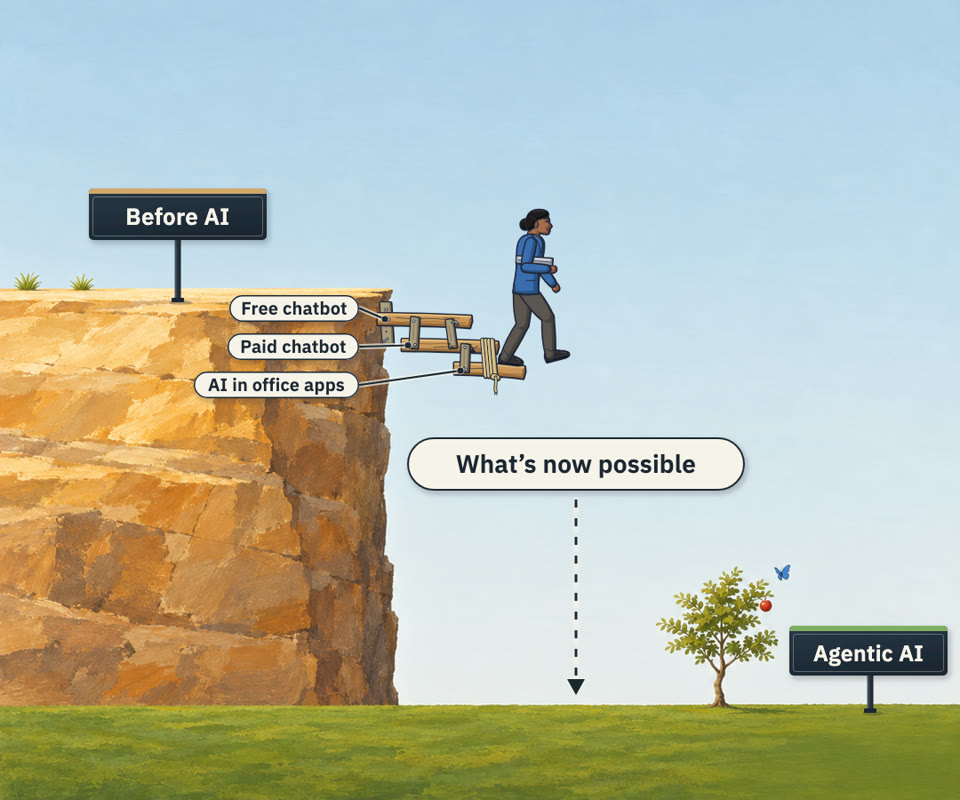
The usual response is a plank. First a policy on free chatbots, then a paid licence, then AI inside the office apps. Each is sensible, and each gets reported as progress.
But every plank is bolted to the old cliff. Each chat still forgets the last one, someone still copies the answers into the spreadsheet, and checking the output is still a person's job. The planks extend the old way of working by a few feet. They don't reach the ground.
The ground is a different way of working: an agent that works on your files, writes and runs the code, checks its own output and records every step, so the work arrives as a draft for a person to review. The parts, in plain words.
Allowed to look. Not to leap.

In many organisations, the analysts have seen the drop and want to go. What stops them is a gate.
The gate is usually there for good reasons. Agentic tools read files, run code and connect to other systems. Data protection rules are tightening, contracts may forbid sending documents to a model, and nobody inside has yet shown that the benefit is worth the risk. Being careful is IT's and information governance's job, and they are right to do it.
The trouble is a catch-22: nobody can show the benefit without access, and nobody will grant access until the benefit is shown. One objection is enough to stall a tool, and there's no evidence to answer it with.
An example project, before anyone opens the gate
If your organisation isn't allowing agentic AI yet, we can break the circle from outside it. We take on one example project on our own set-up, so nothing needs approving to start.
- Your task, our machine. You choose a real piece of work: an analysis, a model, a report or a procedure. We run it on public, synthetic or de-identified data, or on your methods and code with no data at all. Nothing of yours enters a tool you haven't approved.
- The implementation, shown. You see where the agent takes the pain out of the build: the code, the checks, the documentation and the rework, with every step recorded so anyone can follow it.
- The evaluation, side by side. We compare it with how the work is done now: time taken, errors caught, what a reviewer can trace, what it cost. You keep the evidence and the full record.
- Then the advice. Once the benefit is shown, we set out what it would cost to work this way (subscriptions, tooling, set-up time) and how to set it up safely: which tools, which data may go where, what the agent may do on its own and what needs a person, and how every action is logged.
Everything is written for the people who hold the gate, in their terms. They get evidence on your own kind of work, the risks named and costed, and a set-up they can approve or refuse on its merits.
The example project has a fixed price, agreed before we start. The button opens an email to us, copied to Rabbie, our robot, who keeps the diary. Or write to hello@ktandb.co.uk, or call or WhatsApp +44 7533 954328.
Already past the gate?
If you can use agentic tools now, start with your own work: see every way to work with us, or book a first session.